2026-11-04
Riding the Data Wave: Reflections at the Close of the Three-Year Action for “Data Elements ×”
Source:people.cn
QINGDAO, Shandong Province, October 23 — The award ceremony for the national finals of the 2026 “Data Elements ×” Competition was held in Qingdao on October 23, bringing to a close an annual competition that drew more than 29,000 teams and over 145,000 participants. A total of 330 projects stood out in the national finals and received awards.
At the competition, application scenarios expanded, data circulated more rapidly, and stakeholders across sectors gained a deeper understanding of the value of data. Beyond the competition, a clearer path was taking shape—one in which application scenarios drive demand and data circulation translates data into value.
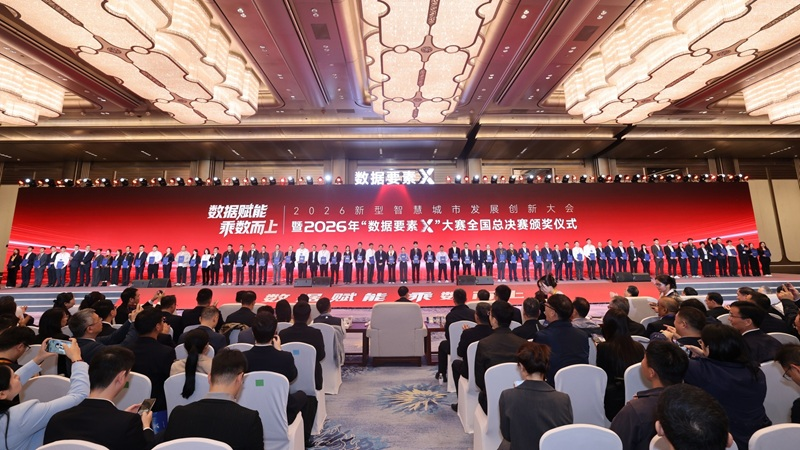
The award ceremony for the national finals of the 2026 “Data Elements ×” Competition. (Photo courtesy of the organizer)
Riding the Data Wave: From Competition to Marketplace
The Qingdao finals generated more excitement than many had anticipated.
In the industrial manufacturing track, a team from SUPCON Technology Co., Ltd., composed primarily of employees born after 1995, was making its third appearance in the competition.
“In our first year, we started with a small use case focused on accumulating industrial knowledge. In the second year, we moved on to practical applications. This year, we have taken the project a step further, developing a new model for the intelligent transformation of an entire factory,” a team member said.
Similar stories unfolded across multiple tracks. This year’s competition featured 16 industry-specific tracks spanning industrial manufacturing, modern agriculture, commercial circulation, transportation, financial services, scientific and technological innovation, healthcare, meteorological services, urban governance, green and low-carbon development, and sports, as well as one specialized track dedicated to data infrastructure. Together, these tracks addressed key priorities in economic and social development. Participants included companies, universities, research institutions, government agencies, and public institutions.
According to information released at the competition, more than 70,000 teams have participated in the “Data Elements ×” Competition over the past three years. The “Data Elements ×” Initiative has identified more than 1,000 high-value application scenarios, far exceeding its initial target of 300.
“Data is playing an increasingly prominent role in the competition.” That is how Ouyang Rihui, assistant dean of the China Center for Internet Economy Research at the Central University of Finance and Economics, sees it after serving as a judge for three consecutive years. Behind this growing momentum is a steadily deepening understanding among stakeholders of how to develop and utilize data.
Sun Yi, a professor at the University of Chinese Academy of Sciences and a competition judge, identified three key factors behind successful data-related projects: real-world application, multiplier effects, and market-driven development.
“The high-quality circulation and utilization of data elements have become a key source of momentum for developing new quality productive forces,” Sun Yi said.
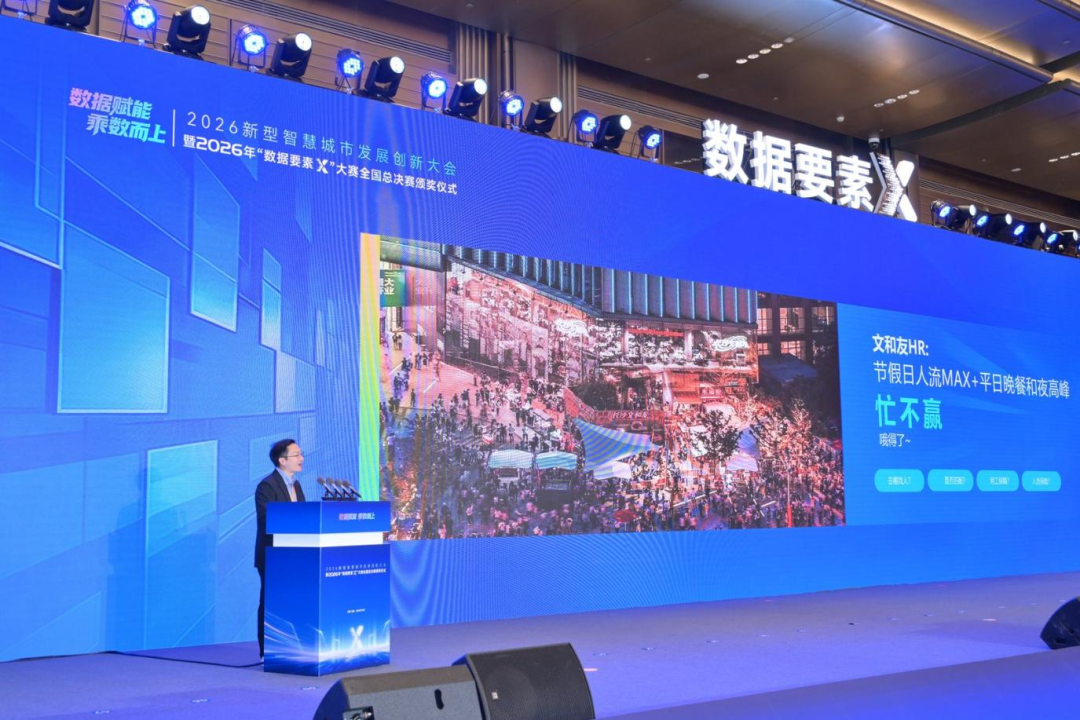
First-prize-winning teams at the national finals of the 2026 “Data Elements ×” Competition share their experiences. (Photo courtesy of the organizer)
Breaking New Ground: Harnessing System-wide Coordination to Unlock Multiplier Effects
The distinctive appeal of data elements lies in the power of the “×” sign. The projects showcased at the competition offer vivid examples of how the concept of “Data Elements ×” is being put into practice.
A “dual-source integration” project developed in Xiangtan’s medical insurance sector brings together two types of data: in-hospital medical insurance settlement data and data from wearable devices and health checkups. The project brings together 480 million data records each year, covering 2.5 million insured inpiduals. It has helped reduce hospitalization rates for chronic diseases by 8 to 15 percent, cut the time required for eligibility assessments for outpatient coverage of chronic and special diseases to one to three working days, and generate annual savings of more than 10 million yuan for the medical insurance fund.
Sichuan Jiaozi FinTech has developed a solution to overcome the challenges of integrating public-sector, financial, and commercial data. JD Logistics is leveraging data from across its operations to bring Level 4 autonomous driving into real-world applications across global commerce and logistics. The Sanxingdui Museum has integrated data governance into every stage of the life cycle of its cultural relics…
These cases point to a common lesson: the value of data lies in its integration and circulation. According to the information, more than 60 percent of participating projects at the competition have adopted innovative data circulation models, such as exchanging data for orders or services.
Over the past three years, the National Data Administration has worked with relevant stakeholders to develop a “531” framework for advancing the reform of the market-based allocation of data elements. The framework calls for coordinated efforts in five areas: establishing foundational data systems, developing data infrastructure, promoting data integration and application and developing application scenarios, building a nationally integrated data market, and fostering the data industry. It also seeks to strengthen three key foundations: core technology development, data standardization, and digital talent cultivation, while making the role of data elements in advancing AI innovation a key priority.
Three years of sustained efforts have helped move data elements from “proof of concept” to “tangible value creation.” According to figures released by the National Data Administration in June 2026, the total volume of active data nationwide reached 1.67 zettabytes (ZB) in 2025, up 28.46 percent year on year. The number of data products and services offered by businesses increased by 29.29 percent, while the transaction value of these products and services rose by 39.8 percent.
As institutional frameworks take shape, application scenarios gain traction and the data market becomes more active, the multiplier effect of data is gradually being unlocked and amplified.
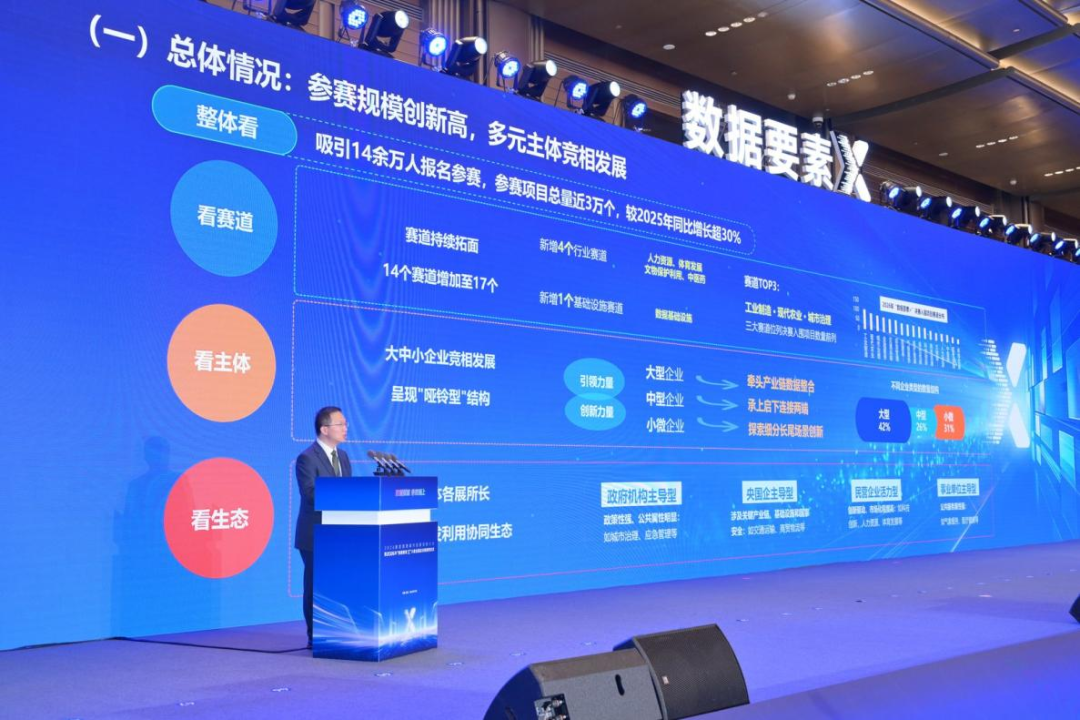
Hu Jianbo, president of the National Data Development Research Institute, releases the An In-Depth Analysis Report on the 2026 “Data Elements ×” Competition at the award ceremony. (Photo courtesy of the organizer)
A New Chapter: Taking Data-driven Development to New Heights
The competition has ended, but the story of “Data Elements ×” is far from over.
The most lasting impact of the three-year action has been to transform “data as a factor of production” from a policy concept into a shared practice across industries.
The Big Data Center of the National Healthcare Security Administration is harnessing the trusted circulation of drug traceability data from the medical insurance system to support the development of the health economy. The Shanghai Big Data Center is leveraging citywide spatiotemporal data infrastructure to improve the precision and sophistication of governance in a megacity. The Shandong Provincial Department of Emergency Management is leveraging the mutually reinforcing role of high-quality datasets and AI to enhance intrinsic safety in the chemical industry… Data elements are becoming woven ever more deeply into the fabric of the national economy.
The designation of 2026 as the “Year of Unlocking the Value of Data Elements” is finding concrete expression in application scenarios that are measurable and replicable.
“The policy toolkit for reforming the market-based allocation of data elements is becoming more comprehensive, and the roadmap for implementation is becoming clearer. Together, these developments are accelerating efforts to unlock the value of data elements,” Liu Liehong, head of the National Data Administration, said at a press conference held by the State Council Information Office in March.
The foundations laid by the three-year action will continue to drive progress during the 15th Five-Year Plan period.
From “Data Elements ×” to “AI Plus,” data is becoming a key factor of production in the intelligent economy. At the competition, more than 80 percent of participating projects have built high-quality datasets for their respective industries, while new business models involving AI agent deployment and model services are emerging rapidly.
The National Data Development Research Institute estimates that the scale of China’s data industry could exceed 10 trillion yuan during the 15th Five-Year Plan period.
Data-driven development is gaining momentum. As institutional frameworks continue to improve, application scenarios expand, and the data market becomes more dynamic, the multiplier effect embodied in the “×” sign will be fully unleashed and continue to generate value over the long term.
Source: people.cn